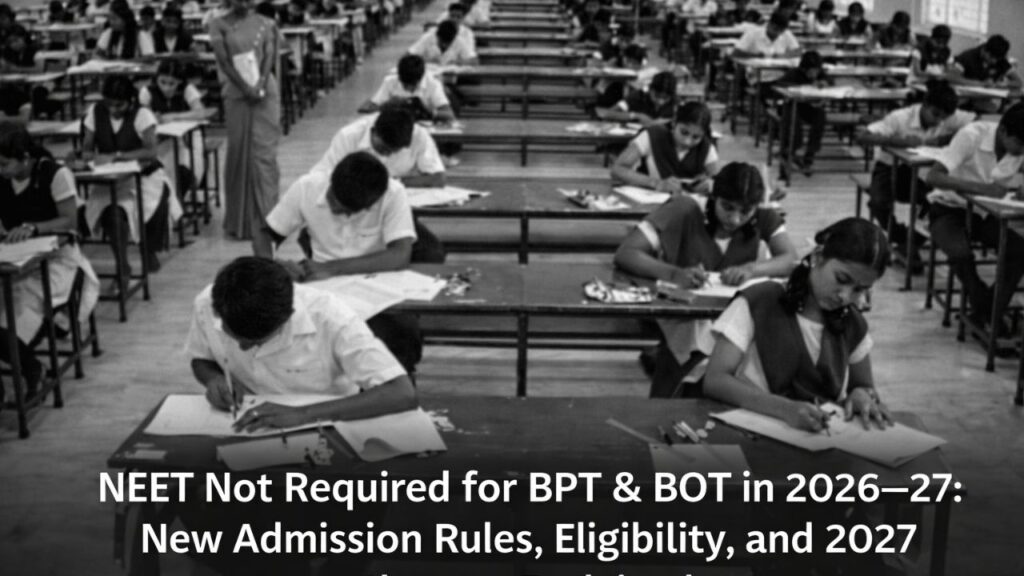
Big news for students who want to study physiotherapy or occupational therapy. You do not need NEET for admission this year. The government has officially deferred the NEET requirement for BPT and BOT courses until the 2027–28 academic session. Here is everything you need to know in simple words.
If you are a student who passed Class 12 with PCB and wanted to join BPT or BOT but were worried about NEET, this news is for you. The rules have changed for this year. Let me explain what happened and what it means.
What Has Changed in 2026?
The National Commission for Allied and Healthcare Professions issued a notification on March 2, 2026. This notification clearly states that for the 2026–27 academic session, students can take admission into BPT and BOT courses without appearing for NEET-UG.
Instead, admissions will be based on:
- Your Class 12 marks
- Merit lists prepared by colleges or state governments
But remember one thing – this is only for this year. It is a temporary change, not a permanent removal.
Updated Admission Criteria for 2026–27
Now let us look at what you need to qualify for admission this year.
Merit-Based Selection
Your admission will be based on your Class 12 marks in PCB – Physics, Chemistry, and Biology. No national entrance exam is required. Different colleges or states may prepare their own merit lists, but the basis is your board exam scores.
Minimum Qualifying Marks
The minimum marks you need depend on your category.
- For General and EWS students: minimum 50 percent aggregate in PCB
- For SC, ST, OBC (NCL), and PwBD students: minimum 40 percent aggregate in PCB
Make sure you meet these percentages in your Class 12 board exams.
English Requirement
You must have passed English as a core subject in Class 12. This is mandatory for admission.
Alternative Admission Routes
Even though NEET is not required this year, some states may still conduct their own entrance exams. Government colleges may also have separate merit systems. So you should check the admission rules of the college or state where you want to apply.
Why Was NEET Requirement Delayed?
You might wonder why the government decided to postpone the NEET requirement. There are good reasons for this decision.
The decision was taken after discussions with the Ministry of Health and Family Welfare and the National Testing Agency.
Logistical Challenges
Adding BPT and BOT courses to NEET would have increased the number of candidates by a huge margin. The exam infrastructure would have faced pressure. Conducting exams for so many additional students in 2026 was not practical.
Sudden Demand Surge
Allied health courses like BPT and BOT have become very popular in recent years. More students want to join these courses than ever before. Immediately adding them to NEET would have disrupted the admission system.
System Readiness
The authorities needed more time to standardize the curriculum and align all institutions across the country. One more year gives them time to prepare properly.
What Will Change from 2027–28
The relief is only for this year. From the 2027–28 academic session, major changes will come into effect.
NEET Becomes Mandatory
All students who want to join BPT or BOT from 2027 must appear for NEET-UG. It will be required for admission and for counselling eligibility. There will be no alternative route.
Standardized Curriculum
A new competency-based syllabus will be introduced. This will apply to 13 allied healthcare professions, not just BPT and BOT. The goal is to ensure that students across India get the same quality of education.
Mandatory Registration
After completing your course, you must register with the National Allied and Healthcare Professional Register. Without this registration, you cannot practice legally in India.
Impact on Students
How does this affect you? It depends on when you are planning to take admission.
Benefits in 2026–27
If you are seeking admission this year, here is what you gain:
- No pressure of preparing for NEET
- Faster admission process since you are not waiting for exam results
- More opportunities because admissions are based on Class 12 marks
If your board exam scores are good, you have a real chance this year.
Challenges Ahead
But if you are not ready to join this year, or if you plan to take admission later, be careful. The relief is temporary. Students preparing for 2027 admission must start targeting NEET now.
Strategic Advice
Here is what you should do based on your situation.
If you want admission in 2026–27:
- Focus on your Class 12 PCB scores
- Check the admission rules of the colleges you are interested in
- Apply early because merit-based seats fill fast
If you are planning for 2027 or later:
- Start preparing for NEET-UG
- Do not assume the NEET requirement will be delayed again
- Keep an eye on official notifications for any updates
Impact on Colleges and States
Colleges and states also need to adjust to these new rules.
Flexible Admission Process
For 2026–27, colleges can design their own merit lists. States can conduct their own entrance exams if they wish. There is flexibility in how admissions happen.
Transition Preparation
From 2027, everything changes. Colleges must prepare for NEET-based admissions. They also need to implement the new curriculum standards. The next one year is a preparation period for institutions as well.
Difference Between 2026 and 2027 Admission Systems
Here is a simple comparison to help you understand.
2026–27 Admission System
- NEET not required
- Merit-based admission using Class 12 marks
- Flexible system with state and college-level variations
2027–28 Onwards Admission System
- NEET mandatory for all students
- Centralized admission system
- Standardized education with uniform curriculum
- Mandatory registration with national register
Why This Decision Matters
This policy is important for several reasons.
It ensures a smooth transition to a national system. Instead of forcing all changes at once, the government is giving students and institutions one year to prepare.
It reduces pressure on students in 2026. Thousands of students who were unsure about their admission plans now have clarity.
It allows better long-term regulation of allied health education. By 2027, the system will be fully ready to handle the increased demand and standardized processes.
Conclusion
The temporary removal of NEET for BPT and BOT admissions in 2026–27 is good news for students who want to join these courses this year. You can now get admission based on your Class 12 PCB marks. No NEET pressure, no waiting for exam results.
But remember, this is only for the 2026–27 session. From 2027–28 onwards, NEET becomes mandatory. Students aiming for admission in future sessions must prepare accordingly.
If you are applying this year, check the merit requirements of your preferred colleges. Make sure you meet the minimum percentage for your category. And keep your English subject result ready.
If you are preparing for next year, start your NEET preparation now. The system is moving toward standardization, and being ready early will only help you.
This transition marks a big step toward making allied healthcare education better in India. More transparency, better quality, and clearer career paths are coming.
Frequently Asked Questions
Q: Is NEET required for BPT and BOT admission in 2026–27?
A: No. For the 2026–27 academic session, NEET is not required. Admissions will be based on Class 12 PCB marks and merit lists.
Q: What are the minimum marks required for admission?
A: General and EWS students need 50 percent aggregate in PCB. SC, ST, OBC (NCL), and PwBD students need 40 percent aggregate in PCB.
Q: Is English compulsory for admission?
A: Yes. You must have passed English as a core subject in Class 12.
Q: Why was NEET requirement delayed?
A: The delay was due to logistical challenges, sudden demand surge, and the need for system readiness. Authorities needed more time to standardize curriculum and align institutions.
Q: Will NEET be required from next year?
A: Yes. From the 2027–28 academic session, NEET-UG will be mandatory for admission to BPT and BOT courses.
Q: Can states conduct their own entrance exams in 2026?
A: Yes. Some states may conduct state-level entrance exams. Government colleges may also follow separate merit systems.
Q: What is the National Commission for Allied and Healthcare Professions?
A: It is the regulatory body that issued the notification deferring the NEET requirement for BPT and BOT courses.
Q: What changes from 2027 onwards?
A: From 2027, NEET becomes mandatory, a standardized curriculum will be introduced, and graduates must register with the National Allied and Healthcare Professional Register to practice.
Q: Should I prepare for NEET if I want to join BPT in 2027?
A: Yes. If you are planning admission for 2027 or later, you should start preparing for NEET-UG.
Q: Is this relaxation only for BPT and BOT?
A: Yes. This notification specifically applies to Bachelor of Physiotherapy and Bachelor of Occupational Therapy courses.
Q: What is the deadline for 2026 admissions?
A: Admission timelines vary by college and state. You should check with the institutions you are applying to for specific dates.
Q: Will this policy change again?
A: The notification clearly states NEET becomes mandatory from 2027–28. Unless a new notification is issued, that rule will apply.