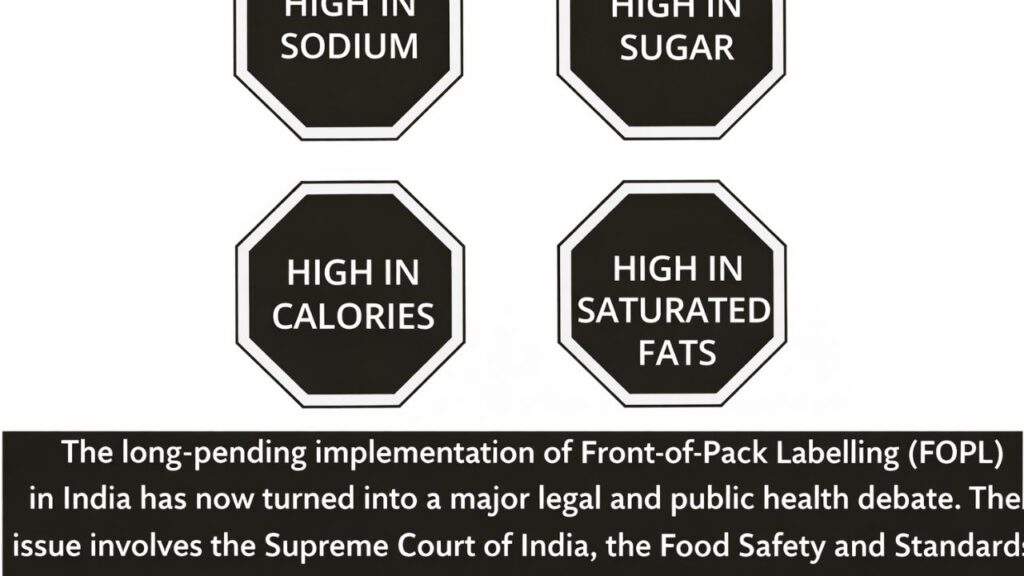
Should food labels inform you or warn you? That is the question at the center of a big debate happening right now in India. The Supreme Court is pushing hard for clear food labels, but the food industry and health experts cannot agree on what those labels should look like. Here is what is happening and how it affects you.
When you go to a shop and pick up a pack of biscuits or a bottle of juice, do you really know what is inside? Most of us do not have time to read the small print on the back. We trust the front of the pack. But that trust can be misleading.
The government wants to change that. Let me explain what Front-of-Pack Labelling is, why it is stuck, and what the Supreme Court is doing about it.
What is Front-of-Pack Labelling (FOPL)?
Front-of-Pack Labelling is exactly what it sounds like. It is a system where important nutrition information is put on the front of food packets, not hidden on the back.
Instead of turning the pack around and reading complicated numbers, you can look at the front and instantly know if the food is healthy or not.
The goal is simple:
- Help consumers understand health risks quickly
- Compare different products easily
- Avoid foods that are unhealthy
Right now, many people buy products without knowing how much sugar, salt, or fat is inside. FOPL aims to change that.
The Core Conflict: Star Ratings vs Warning Labels
This is the main reason FOPL is delayed. Two different systems are being debated, and each has strong supporters.
1. Health Star Rating System (Supported by Food Industry)
In this system, products get a rating from half a star to five stars. More stars mean healthier.
The food industry prefers this system because:
- It looks positive and encouraging
- Companies can still market their products
- It does not directly warn consumers away
The Problem
Health experts say this system creates a “health halo effect”. A product with three stars might still have too much sugar or salt, but consumers think it is healthy because they see stars. Good ingredients can hide the bad ones.
2. Warning Label System (Supported by Health Experts)
This system uses bold symbols like black octagons or red circles. The label clearly says “High in Sugar” or “High in Salt” or “High in Fat”.
Health experts and groups like NAPi support this system because:
- It is simple and direct
- Even people with low literacy can understand
- There is no confusion about whether a product is healthy or not
The Advantage
If you see a black octagon on a pack of chips that says “High in Salt”, you know immediately that this is not good for you. No reading, no calculating, no confusion.
Supreme Court’s Intervention (March 2026)
The Supreme Court has now stepped in because the debate has been going on for too long.
Strong Observations
The court expressed serious dissatisfaction with the delays. They noted that discussions have continued for nearly eight years without any concrete action. Eight years is a long time when public health is at stake.
Right to Health Priority
The court made it clear that citizens’ right to health must come first. This cannot be compromised for corporate interests. If food companies are worried about sales, that is not as important as people’s health.
Deadline Pressure
FSSAI was given a four-week deadline to finalize the system. Later, they requested six more weeks. The court has warned that if no concrete plan is presented, they may step in and impose binding rules themselves.
Timeline of Key Developments
Here is how events unfolded in early 2026.
February 10, 2026
The court reviewed the compliance report and found that there was no clear progress. Things were moving too slowly.
February 15, 2026
Reports showed that 33.6 percent of food labels are either non-compliant or misleading. More than one-third of food packs are not giving consumers clear information.
March 13, 2026
FSSAI submitted a proposal considering both tabular labels and pictorial warnings. They are still exploring options.
March 19, 2026
A fresh stakeholder consultation was held in New Delhi. Industry representatives and health experts met again, but no final decision was reached.
Why FOPL is Important for India
You might wonder why this matters so much. Here is why.
Rising Health Concerns
India is facing a huge increase in non-communicable diseases. These are lifestyle diseases like:
- Diabetes
- Heart disease
- Obesity
These diseases now account for nearly 60 percent of all deaths in India. The food we eat plays a big role in this.
Lack of Awareness
Most consumers cannot understand the complex nutrition labels on the back of packs. Terms like “energy” and “carbohydrates” mean nothing to ordinary people. Misleading packaging with words like “natural” or “healthy” influences buying decisions.
FOPL can solve this by making information simple and clear.
Potential Impact on Consumers
If FOPL is implemented effectively, here is how it will help you.
Faster Decision-Making
You will be able to identify unhealthy products in less than ten seconds. No need to search for small print or understand complicated numbers.
Healthier Choices
When you clearly see that a product is high in sugar or salt, you can choose something else. Over time, this can lead to better diet habits.
Pressure on Food Companies
When consumers start avoiding products with warning labels, companies will be forced to change. They will reduce sugar, salt, and fat in their products to avoid those labels.
Impact on Food Industry
The food industry is naturally concerned about these changes.
Increased Accountability
Companies will no longer be able to hide unhealthy ingredients behind attractive packaging. They will have to be honest about what is inside.
Product Reformulation
Many companies will need to change their recipes. They will have to reduce sugar, salt, and fat to keep their products appealing to consumers.
Market Competition
Healthier products may gain an advantage. Companies that reformulate early could benefit, while those that resist may lose customers.
Challenges in Implementation
Despite the benefits, putting FOPL into practice is not easy.
Industry Resistance
The food industry is worried about sales impact and brand perception. They prefer the star rating system because it is less damaging to their products.
Consumer Education
Even with clear labels, people need to understand what they mean. Awareness campaigns will be necessary to teach people how to use the labels.
Regulatory Balance
The government must balance public health needs with industry interests. Too much pressure on industry could lead to legal battles. Too little pressure means the system may not work.
What Happens Next
The coming weeks are critical for FOPL in India.
FSSAI must finalize a clear roadmap. The Supreme Court is watching closely. If delays continue, the court may step in and impose its own rules.
India is at a turning point. The decision made in the next few weeks will shape how food is labelled and how people make choices for years to come.
Conclusion
The Front-of-Pack Labelling debate is not just about labels. It is about the health of millions of Indians.
With rising rates of diabetes, heart disease, and obesity, clear food labelling has become essential. Whether India adopts star ratings or warning labels, the goal is the same – empowering consumers to make healthier choices quickly and confidently.
The Supreme Court has pushed hard to get this done. FSSAI is now under pressure to deliver. For consumers, this means change is coming. Soon, you may look at a pack of biscuits and see a clear warning if it is high in sugar. Or you may see stars that tell you how healthy it is.
Whatever system wins, the important thing is that you will finally know what you are eating. And knowing is the first step to choosing better.
Frequently Asked Questions
Q: What is Front-of-Pack Labelling (FOPL)?
A: FOPL is a system where nutrition information is displayed clearly on the front of food packaging, helping consumers understand health risks quickly without reading complicated back labels.
Q: What are the two systems being debated?
A: The two systems are the Health Star Rating system (0.5 to 5 stars) preferred by the food industry, and the Warning Label system (bold symbols showing high sugar, salt, or fat) supported by health experts.
Q: Why has FOPL implementation been delayed?
A: The delay is due to disagreement between the food industry and health experts over which labelling system should be used. The debate has continued for nearly eight years.
Q: What did the Supreme Court say about FOPL?
A: The Supreme Court expressed dissatisfaction with the delays, emphasized that citizens’ right to health must come first, and warned that they may impose binding rules if no concrete plan is presented.
Q: How will FOPL help consumers?
A: FOPL will help consumers identify unhealthy products in seconds, compare products easily, and make better food choices without needing to understand complex nutrition labels.
Q: What is the Health Star Rating system?
A: It is a system where products receive a rating from 0.5 to 5 stars based on their nutritional profile. More stars indicate healthier products.
Q: What is the Warning Label system?
A: It is a system that uses bold symbols like black octagons or red alerts to clearly mark products that are high in sugar, salt, or fat.
Q: Why do health experts prefer warning labels?
A: Health experts prefer warning labels because they are simple, direct, and easy for all consumers to understand, including those with low literacy.
Q: Why does the food industry prefer star ratings?
A: The food industry prefers star ratings because they look positive, allow for marketing, and do not directly warn consumers away from products.
Q: What happens if FSSAI does not act soon?
A: The Supreme Court has warned that if FSSAI does not present a concrete plan, the court may step in and impose binding rules on food labelling.
Q: How will FOPL affect food companies?
A: Food companies will face more accountability, may need to reformulate products to reduce sugar, salt, and fat, and will have to compete on healthier offerings.
Q: When will FOPL be implemented?
A: No final date has been set. The Supreme Court has given FSSAI deadlines, and the coming weeks will determine when implementation begins.